The Silent AI Revolution
AI adoption is already happening in your organization—just not the way you think
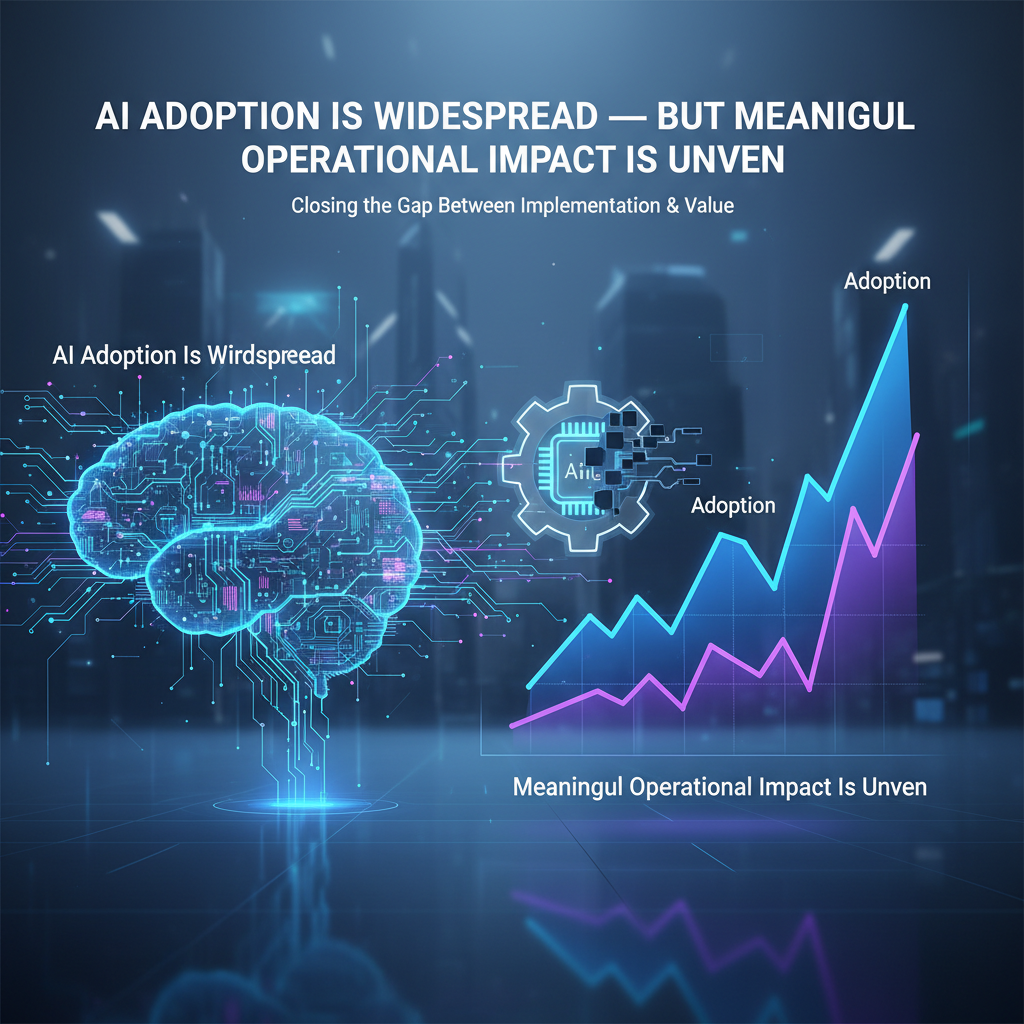
AI adoption inside enterprises is no longer a future ambition. It is already happening, quietly and unevenly, across teams and roles. Employees are experimenting with AI tools to write, analyze, summarize, plan, and automate parts of their daily work. This article examines why this bottom-up usage is not translating into organizational capability or business impact.
The Reality Most Leaders Are Missing
In many organizations today, AI usage has already crossed the point of no return. Employees are using generative AI tools during late nights, in personal browsers, or through unofficial workflows. They are drafting emails, preparing presentations, exploring data, generating ideas, and accelerating routine tasks.
This is not driven by formal programs. It is driven by individual curiosity and pressure to perform better and faster. However, from a leadership perspective, this usage is largely invisible. There is little clarity on who is using AI effectively, which use cases are actually improving outcomes, and where risks are being introduced.
As a result, leaders often conclude that AI adoption is "early" or "slow," when in reality it is happening without structure or alignment. This creates a dangerous situation: AI is being used, but the organization is not learning from it.
Why Informal AI Usage Does Not Become Enterprise Capability
The core problem is not lack of tools or access. Most organizations already have access to powerful AI platforms. The problem is that informal usage does not automatically translate into capability.
The Fragmentation Problem
- Learning is invisible: No shared understanding of what works and why
- Success cannot be repeated: Valuable discoveries remain isolated
- Decisions lack confidence: Leadership cannot assess readiness for scale
Without a system to observe, evaluate, and consolidate learning, AI remains a personal productivity hack rather than an organizational advantage. This is where capability building becomes critical.
The Limits of Traditional AI Rollouts and Training
Many enterprises respond to this gap by launching top-down AI initiatives. These usually take the form of company-wide training programs, tool rollouts, or centrally defined use cases. While well-intentioned, these approaches often fail to produce meaningful results.
The underlying issue is that these approaches treat AI adoption as a rollout problem, not a learning problem. Organizations exploring AI sandboxes are finding better results by focusing on experimentation first.
AI Adoption Is Fundamentally a Learning Challenge
💡 Key Insight: AI behaves differently from traditional enterprise technology. It is flexible, probabilistic, and deeply dependent on how people interact with it. Value emerges through experimentation, iteration, and adaptation within real work contexts.
This means organizations cannot fully design AI adoption upfront. They must learn their way into it. That learning cannot be left to chance or individual initiative. It must be structured, observable, and connected to decision-making.
A learning-first approach recognizes that early AI usage is messy by nature. Some experiments will fail. Some will succeed unexpectedly. The goal is not to eliminate this messiness, but to harness it. Organizations need mechanisms to surface promising patterns, understand why they work, and decide what is worth scaling.
The Visibility Gap: What Leaders Cannot See
Questions Leaders Cannot Answer
In most organizations, these questions cannot be answered with confidence. Data on AI usage is either unavailable or meaningless. Anecdotes replace evidence. Decisions are made based on enthusiasm rather than insight. This lack of visibility leads to two extremes: some leaders slow down adoption out of caution, while others push aggressive rollouts without evidence.
From Individual Experimentation to Organizational Learning
To bridge this gap, enterprises must shift their focus. The goal should not be to force adoption or standardize usage prematurely. The goal should be to create conditions where learning can happen systematically.
What This Requires
When learning is structured this way, organizations can begin to answer important questions. They can see which roles are becoming AI-ready. They can identify use cases that consistently deliver value. They can distinguish between novelty and impact. Organizations working with AI transformation consulting are implementing these structured learning systems.
What a Learning-Centered Approach Enables
Evidence-Based Decisions
Move from assumptions to data-driven strategy
Targeted Investments
Allocate resources where they deliver real value
Reduced Risk
Scale follows proof, not hype
Sustainable Growth
Build capability that compounds over time
Most importantly, the organization begins to develop a shared understanding of what AI means in practice. Not as a buzzword, but as a set of capabilities embedded in everyday work. This is the foundation of sustainable AI adoption.
Where Ambilio Fits in This Shift
Ambilio was built around this exact gap between individual AI usage and organizational readiness. Rather than starting with predefined use cases or generic training, Ambilio provides enterprises with structured environments where teams can explore AI within their roles and workflows.
These environments make experimentation visible, repeatable, and measurable. They allow organizations to observe how AI is actually being used, where it delivers value, and where it does not. This creates a factual basis for decisions about readiness, scaling, and investment.
The intent is not to accelerate adoption blindly, but to help enterprises decide what is worth adopting at all. Learn more about our AI transformation products.
Closing Thoughts
AI is already inside your organization, whether you planned for it or not. The real question is whether your organization is learning from it.
Without visibility, structure, and feedback loops, AI usage will remain fragmented and fragile. Enterprises that succeed will not be those that roll out AI the fastest, but those that learn the fastest. They will turn scattered experimentation into shared capability and informed action.
The gap between employees using AI and organizations adopting it is not a technology gap. It is a learning gap. And that gap can be closed deliberately, if it is acknowledged early and addressed thoughtfully.
Ready to Bridge the Gap?
Discover how structured AI learning can transform scattered experiments into organizational capability.
Explore Our Capability Building →